Undisclosed Resellers
Definition & Explanation
Undisclosed resellers are intermediaries that take a cut of an impression without appearing in the record the buyer can inspect. The bid request looks like it came from one seller. It actually moved through a company that never shows up in it.
Three files exist to prevent that. ads.txt names the sellers a publisher has authorized and marks each relationship DIRECT or RESELLER. sellers.json names the company behind a seller ID and marks the account PUBLISHER, INTERMEDIARY, or BOTH. The SupplyChain Object, passed as schain in the bid request, lists the nodes an impression travelled through and flags whether that chain is complete (1).
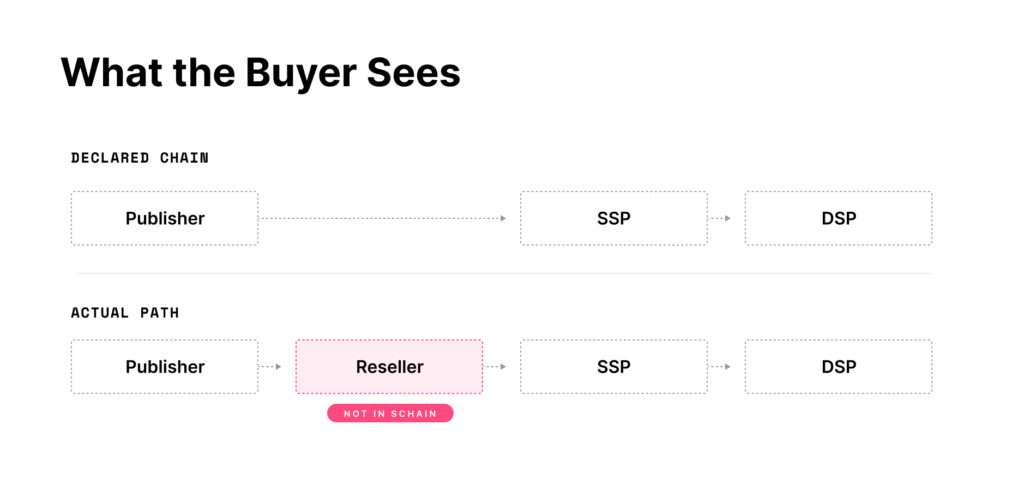
A reseller goes undisclosed when one of those files fails to record it, which happens in three ways.
The chain can be cut short. An intermediary buys an impression, sells it on, and leaves its own node out of the schain, so the buyer sees a shorter path than the money actually took.
The role can be misstated. A reseller declares itself PUBLISHER in sellers.json, or an ads.txt row records a resold relationship as DIRECT. Either way the buyer is told it is dealing with the owner of the inventory when at least one party sits in between, and it prices the impression on that basis.
The identity can be withheld. sellers.json permits an entry to be marked confidential, which acknowledges the seller ID while hiding the name and domain attached to it (1).
None of this is the same as unauthorized reselling. An unauthorized reseller is one the publisher never approved, which is what ads.txt catches by listing who is allowed to sell. An undisclosed reseller can be approved, listed, and paid entirely legitimately, and still leave no mark on the transaction the buyer sees.
Why It Matters
A margin nobody can see cannot be priced or weighed against another path, so what the buyer pays and what the publisher books drift apart by an amount neither party can account for.
ISBA and PwC measured that drift. Their 2020 study could not attribute 15% of advertiser spend to any identified party, roughly a third of total supply chain costs, and matched only 12% of 267 million impressions end to end (2). The 2023 follow-up showed what disclosure is worth: unknown delta down to 3%, match rate up to 58%, publisher share of spend up eight points to 65% (3).
Missing nodes also break supply path optimization. Two paths that look equivalent are not, and a buyer can bid against itself across three routes without seeing that they end at the same publisher.
Then there is what fills the gap. A node with no name attached carries no accountability, and that is where inventory gets relabelled. Chain verification only works on a complete chain, which is the mechanical link between supply chain opacity and domain spoofing.
Undisclosed Resellers Across the Ecosystem
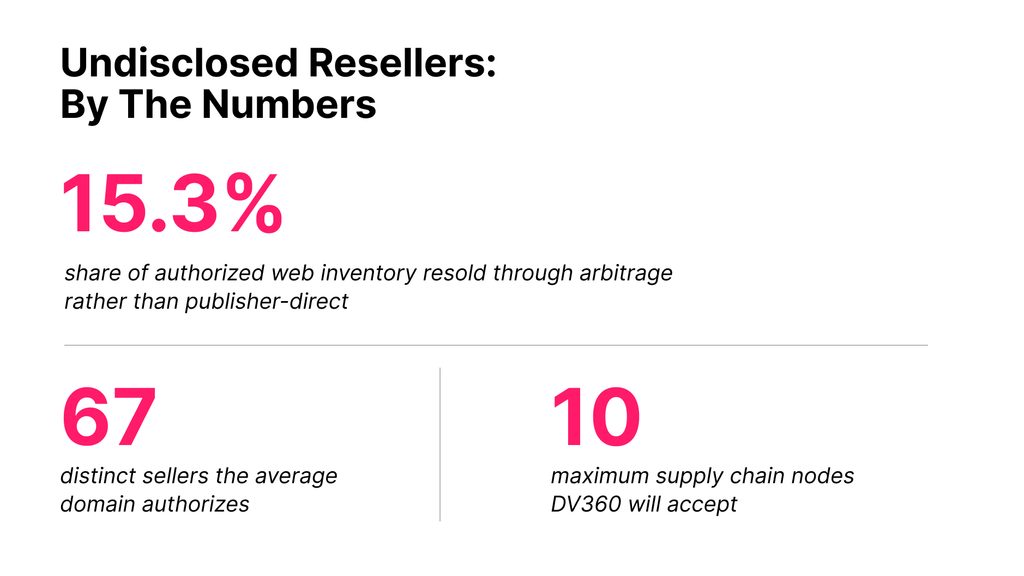
ads.txt covered authorization in 2017. sellers.json and the SupplyChain Object were finalized on 31 July 2019 and covered identity and path (1). Enforcement came from the demand side almost immediately. The Trade Desk told exchanges to publish sellers.json or lose the integration, and 123 had files live by late September that year, including 34 of the 50 most widely adopted (4). DV360 accepts chains of up to 10 nodes, a fair indication of how long a path is assumed to legitimately run (5).
Adoption is near universal now. Completeness is not. Google’s first sellers.json file, in 2020, was 5% complete by Jounce Media’s count, with 53% of entries listing the business name as confidential and 42% missing a domain (6). Confidentiality has real uses, white label arrangements among them, and the spec still permits it. A mostly confidential file returns the buyer to where they started.
Most buyers have responded by shortening paths rather than auditing them. The ANA’s 2023 study of $123 million in spend found that 36 cents of every dollar entering a DSP reached the consumer, and recommended working from a list of 75 to 100 trusted sellers with direct connections instead of the 40,000 site footprints most campaigns were carrying (7).
Undisclosed Resellers in DeepSee.io Metrics
We come at this from the domain side, by testing whether a publisher’s declared record resolves.
Every ads.txt row names a seller ID at an advertising system. We check each one against that system’s sellers.json and report the share that match, which is what sits behind our transparency signals: No Valid Ads.txt Authorized Paths, Majority Unverifiable Ads.txt File, Partially Unverifiable Ads.txt File, and Highly Transparent Ads.txt File. An unmatched row is the footprint of an undisclosed path. The publisher has authorized a seller the platform does not acknowledge, and anyone bidding on that path is taking a claim no second party has confirmed. The full methodology is in the ads.txt article.
File size is the second signal. We flag extremely large ads.txt files because row count tracks the number of selling relationships, and heavy layering means inventory is reachable through many hops rather than few. Large files are not non-compliant. They are just a wider surface for undisclosed paths to sit on.
Sources
- IAB Tech Lab, sellers.json and OpenRTB SupplyChain Object specifications, 2019
- ISBA and PwC, Programmatic Supply Chain Transparency Study, 2020
- ISBA and PwC, Second Programmatic Supply Chain Transparency Study, 2023
- Digiday, To reduce auction duplication, buyers start to enforce sellers.json, 2019
- AdExchanger, Why Sellers.json Is Limited, And How Supply Chain Objects Can Help, 2022
- AdExchanger, Google Releases Incomplete Version Of Its Sellers.json File, 2020
- ANA, Programmatic Media Supply Chain Transparency Study: Complete Report, 2023