Supply Path Optimization (SPO)
Definition & Explanation
Supply path optimization is the practice of deciding which route an impression takes from publisher to buyer, and closing off the routes that add cost or risk without adding value. The same impression is almost never available through a single path. A publisher running header bidding offers each opportunity to every integrated demand partner at once, and any partner authorized to resell can pass that opportunity further down the chain. One ad slot can reach a DSP a dozen or more times in the same auction, at different prices, through different intermediaries, carrying different fees.
SPO has a buy side and a sell side. On the buy side, DSPs and agencies rank the paths available to them and bid only through the ones that are cheapest, cleanest, and most reliably authorized. On the sell side, publishers reduce their demand partner count and prune their ads.txt files so inventory arrives at buyers through fewer, more accountable routes.
Three IAB Tech Lab standards make the work possible:
- ads.txt / app-ads.txt declares which ad systems a publisher has authorized to sell its inventory, and whether each relationship is DIRECT or RESELLER.
- sellers.json is the mirror image, published by each ad system to disclose the sellers and intermediaries it represents (1).
- The OpenRTB SupplyChain object (schain) carries the ordered list of every party that touched the bid request, with each node referencing a sellers.json entry (1).
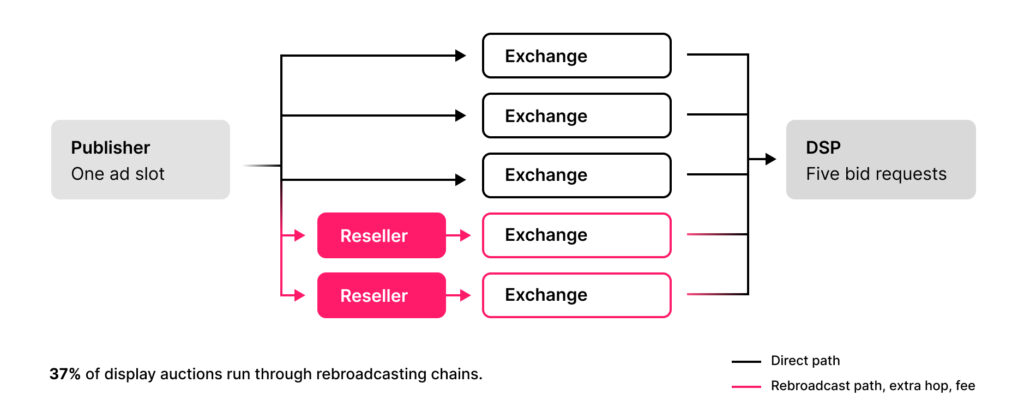
Read together, these let a buyer reconstruct a path before bidding rather than reconciling it after the fact. A maximally direct path runs from the publisher to one exchange to the DSP. A rebroadcast path inserts one or more intermediaries that resell the same impression into the same auction, adding a fee layer and a duplicate bid request at every hop.
Why It Matters
Path choice determines what a buyer purchases, not only what they pay for it. Two routes to the same impression can differ in fee load, in whether the seller is genuinely authorized, and in whether the request represents a real ad opportunity at all. Buying the cheapest available path is not the same as buying the correct one.
The cost layer is the most quantified. The ANA’s Q2 2026 Programmatic Transparency Benchmark put transaction costs at 27.2% of programmatic spend, with market-level TrueAdSpend, the share of investment producing fraud-free, measurable, viewable, non-MFA impressions, at a record 45.1% (3). Every unnecessary hop takes a margin out of that number before the publisher sees a dollar of it.
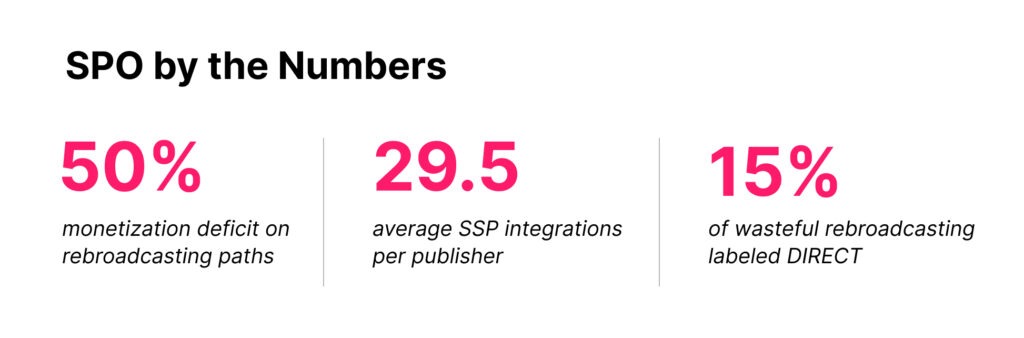
Duplication compounds the problem. When the same impression is offered through fifteen paths, a DSP spends compute evaluating fifteen versions of one opportunity and then bids against itself on the ones it does not filter out. Jounce Media’s data shows rebroadcasting chains account for 37% of display auctions and 32% of video auctions, while maximally direct paths generate roughly twice the spend per bid request (4). Buyers have already priced this in: rebroadcasting paths carry a 50% monetization deficit against direct ones (4).
Unverifiable paths carry the sharper risk. If a bid request arrives through a seller that cannot be matched back to the publisher’s declared authorizations, the buyer has no basis for trusting that the inventory is genuine, which is the precondition for domain spoofing and a common characteristic of MFA supply. The same routes that add fees tend to be the ones that obscure origin.
Concentration works. The 2023 ANA study found the average campaign running across roughly 44,000 websites when fewer than 5,000 would suffice (2). Kimberly-Clark applied log-level data to its path decisions, cut its buy from nearly 29,000 sites to about 1,700, and reduced CPMs by 20% (3). In the Q1 2026 Benchmark, higher-performing advertisers converted 54.0% of spend into qualified impressions against 32.1% for the lower-performing cohort, a record 21.9-point spread, with more concentrated supply footprints named as a defining characteristic of the top group (3).
For publishers, the incentive runs the other way and then doubles back. More demand partners means more bid density and higher short-term yield, which is why partner counts keep climbing. But inventory that reaches buyers primarily through resold paths gets bid down or filtered, and publishers on direct paths capture the premium curated deal spend that buyers route through clean chains.
SPO Across the Ecosystem
The standards are mature and the compliance is not. Sellers.json and the SupplyChain object were finalized for industry adoption in July 2019 (1), six years after ads.txt, and the gaps in the data are still material. HUMAN Security’s analysis of IAB Tech Lab standards adoption found sellers unauthorized on 8.1% of web bid requests, missing sellers.json entries on 8.2%, and OWNERDOMAIN missing from 40% of web requests and 58% of CTV and app requests (5). Missing fields do not only hide bad actors. They cause legitimate inventory to fail validation and lose bids it should have won.
Self-declaration is the weak point. Jounce Media reports that 15% of the bid requests it identifies as wasteful rebroadcasting are labeled DIRECT in the underlying transparency files (4). A DIRECT label is a claim, not a verification, which is why path evaluation has moved toward cross-referencing declared authorizations against observed behavior.
Partner counts continue to expand rather than consolidate. The average RTB-enabled publisher is now integrated with roughly 29.5 sell-side platforms (4), up from 24.5 in early 2025, and the ANA’s Q1 2025 Benchmark found the median number of SSPs used by marketers rising from 14 to 19 even as SPO became standard practice (3). Consolidation is easier to recommend than to execute.
The shape of the market is shifting in response. Private marketplaces now carry 81.6% of spend (3), and curation has absorbed much of the intermediary function that rebroadcasting used to serve, with the structural advantage that a curator cannot generate new duplicate bid requests. Managed wrappers reintroduce the problem from another direction: a publisher running six wrappers appears fully direct in its transparency files while producing six auctions per impression. IAB Tech Lab has proposed extending the SupplyChain object to cover entities that take technical custody of a bid request, including Prebid, ad servers, SSAI platforms, SDKs, and wrappers, using an hp=0 designation for parties outside the payment flow (6). If adopted, SPO shifts from rewarding the shortest-looking path to rewarding the most fully disclosed one.
SPO in DeepSee.io Metrics
DeepSee.io does not observe schain nodes, fee take rates, or auction duplication, and buyers already have log-level data and bidstream tooling for that half of the problem. What we measure is the other half: the domain at the end of the path, and whether its declared authorizations hold up.
Every domain we crawl is checked for a valid ads.txt file, and each declared seller ID is matched against the corresponding sellers.json entry. We report the match rate directly, and flag domains where none of the declared rows resolve, where the majority are unverifiable, and where verification is partial but incomplete. A domain with a high match rate is one whose paths can be traced. A domain where 8% of 4,038 rows resolve is one where most of the supply attributed to it cannot be confirmed as authorized.
File size is a path signal in its own right. Extremely large ads.txt files, those in the top 10% globally, indicate heavy reseller chain layering and a fragmented set of routes to the same inventory. Single-line files usually indicate a young or templated site that has not yet earned meaningful demand.
We also identify the manager of record behind a domain, which matters because path decisions are rarely made at the site level. A single monetization partner may operate thousands of properties on shared infrastructure and shared ad refresh behavior. When we cannot observe a signal on a specific site, we report what we have measured across the rest of that manager’s portfolio, which lets buyers evaluate an entire supply relationship rather than one domain at a time.
Path data is only half of a supply decision. A perfectly direct route to inventory with 50% ad density and a 7-second refresh interval is a clean path to a poor buy. Our authorization signals sit alongside advertising experience, MFA, and IVT signals in the same domain record, and the full set is available through the API and as CSV export, so inclusion lists can be built on both directness and destination quality.
Sources
- IAB Tech Lab, sellers.json and SupplyChain Object specifications
- ANA, Programmatic Media Supply Chain Transparency Study, 2023
- ANA, Programmatic Transparency Benchmark, Q1 2025 through Q2 2026
- Playwire, Jounce Media, Supply Path Benchmarking Report, 2025 and 2026
- HUMAN Security, State of the Union: IAB Tech Lab Supply Chain Standards Adoption
- IAB Tech Lab, Proposed SupplyChain Object Update