Viewability
Definition & Explanation
Viewability is a metric that reports whether a served ad impression actually had the opportunity to be seen. An impression can be recorded the moment an ad loads, even if it renders below the fold on a page the user never scrolls to, inside a background tab, or in a slot the user passes in a fraction of a second. Viewability separates impressions that were merely delivered from those that were genuinely visible.
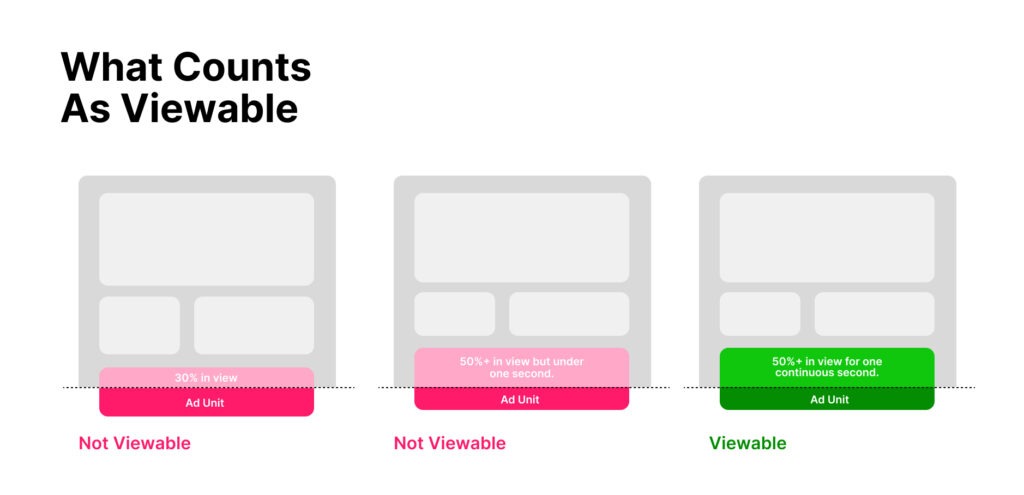
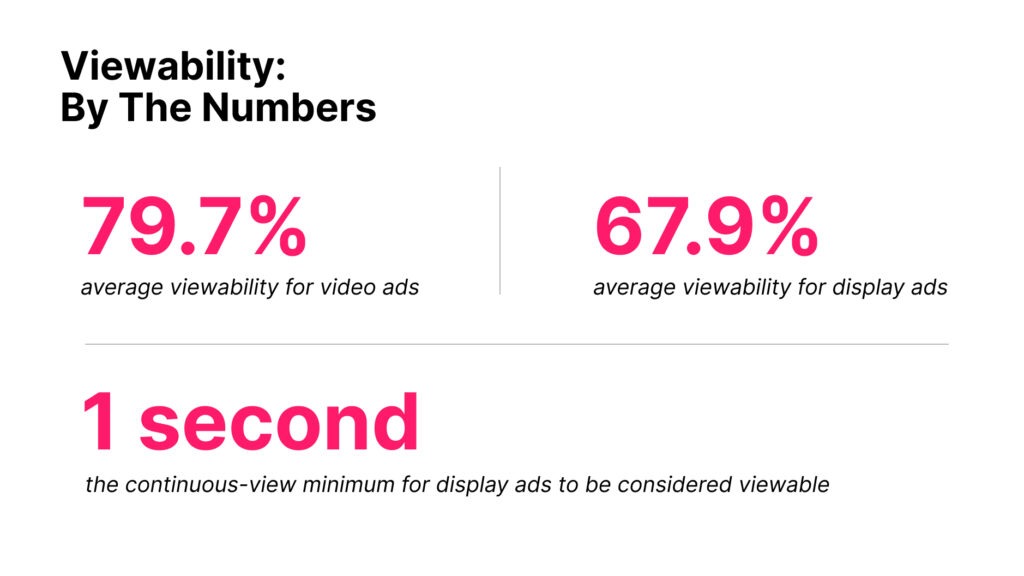
The industry benchmark comes from the IAB and MRC, established in 2014 and still the baseline today. A display ad counts as viewable when at least 50% of its pixels are in the browser’s viewable area for a minimum of one continuous second (1). Video is held to a longer bar: 50% of pixels in view for at least two continuous seconds. Large-format display ads, those above 242,000 pixels, need only 30% of their pixels in view for one second, since occupying half a screen with a full unit is impractical.
Why It Matters
Viewability sets the ceiling on everything a campaign is trying to do. An impression that is never seen cannot build awareness, drive a click, or produce a conversion, no matter how precise the targeting or how strong the creative. It is spend converted directly into waste.
The waste is not marginal. When the MRC standard was being finalized, Google reported that 56.1% of impressions across its display platforms were not viewable (2). More than a decade later, industry-average display viewability still sits in the 50 to 70% range, meaning a large share of paid impressions go unseen even now (3).
For publishers, viewability is a direct input to inventory value. Buyers increasingly transact on viewable CPM (vCPM), paying only for impressions that clear the threshold, and set viewability floors in private marketplace deals. Inventory that consistently underperforms on viewability gets bid down or filtered out of consideration entirely. A publisher’s viewability rate is, in effect, a price signal.
Viewability is also the foundation the rest of measurement is built on. The 2025 IAB and MRC Attention Measurement Guidelines require an ad to clear core viewability thresholds before any attention signal is evaluated (4). If an ad was never viewable, the question of whether it held attention does not arise. Every deeper quality metric inherits viewability as its precondition.
Viewability Across the Ecosystem
Viewability is measured by accredited third-party vendors, often using JavaScript tags that track pixel visibility and time in view. MRC accreditation is what allows measurement to be treated as transactable currency, and with MRC guidance, vendor-to-vendor variance narrows to roughly plus or minus 5 to 10% (1). That consistency is what makes viewable-impression buying possible in the first place.
Certain factors depress viewability regardless of buyer intent. Placement is the largest: below-the-fold slots start at a disadvantage no creative can overcome. Format matters, with sticky and larger units tending to score higher than standard banners. Device and page performance play a role, since slow-loading pages push ads out of view before they render.
Two publisher behaviors sit at the center of the viewability problem, and both are addressable. High ad density crowds the page so that individual units compete for the same limited screen space, reducing the share of any one ad that lands in view. Aggressive ad refresh swaps ads faster than the 30-second guidance can reliably be met, generating impressions that are counted but were never viewable. Both behaviors inflate impression volume while degrading the quality of every impression produced, which is why they draw scrutiny from buyers optimizing for viewable spend.
Viewability in DeepSee.io Metrics
DeepSee does not measure viewability directly. Viewability is a served-impression signal, captured tag-side at the moment of delivery, and specialized verification vendors already measure it against MRC’s accredited standard. Duplicating that measurement would add nothing.
What we measure is upstream of it. Viewability is an outcome, and the strongest predictors of that outcome are decisions a publisher makes about page layout and refresh behavior, both of which we observe directly during crawls. We report ad density across three phases of the user journey, above the fold, in article, and in the footer, and we flag layouts where ads occupy 35% or more of the screen on average or 50% or more at peak. We measure ad refresh timing against the 30-second DSP guidance and flag schedules that fall below it. A site refreshing units every 7.5 seconds is manufacturing impressions that stand little chance of meeting the viewability bar.
Read together, these signals tell a buyer why a domain’s viewability is likely to be poor before a single impression is bought. A verification tag can tell you an impression was not viewable after you have paid for it. Our signals tell you which layout and refresh decisions made that outcome likely in the first place, which is the difference between measuring waste and avoiding it.