Keep Your Ads Out of Environments
That Don't Fit Your Brand
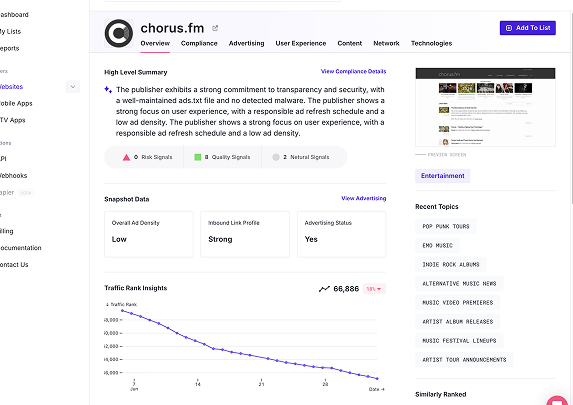
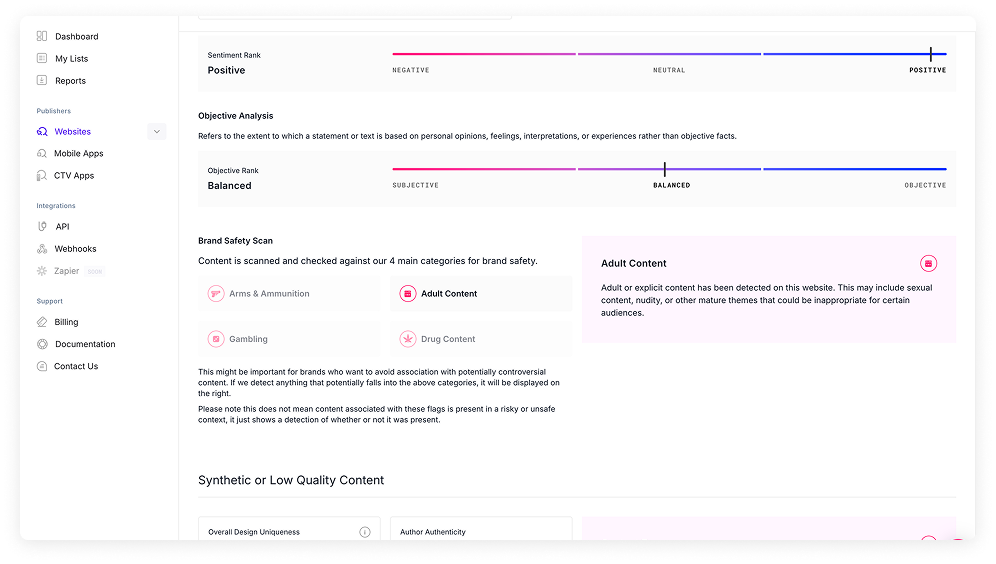
Not every page is a place your campaign belongs. DeepSee.io scans for what gives advertisers pause: drugs,
gambling, adult material, firearms. You get category-level signals instead of blunt keyword blocking that buries
reputable content along with the risky.
Looking Out For Dangers To Your Brand
Dedicated Brand Safety Categories
DeepSee scans page content for drugs, gambling, adult material, and firearms- the four categories that most often sit outside a brand's comfort zone. Each is flagged independently, so you see exactly which sensitive content appears rather than a single vague "unsafe" verdict.
Misinformation Signal
DeepSee flags domains that appear on the Iffy Index, a respected third-party list of news sources that repeatedly fail professional fact-checks. Because the index judges factual reporting rather than political leaning, it's a credibility signal advertisers can act on without wading into partisan territory.
Suitability, Not Just Safety
Signals are designed to inform brand suitability decisions, what's unacceptable for one advertiser may be fine for another, rather than enforce a single universal standard. You get the underlying detection and set the threshold that fits your use case.
Looking Out For Dangers To Your Brand
Dedicated Brand Safety Categories
DeepSee scans page content for drugs, gambling, adult material, and firearms- the four categories that most often sit outside a brand's comfort zone. Each is flagged independently, so you see exactly which sensitive content appears rather than a single vague "unsafe" verdict.
Misinformation Signal
DeepSee flags domains that appear on the Iffy Index, a respected third-party list of news sources that repeatedly fail professional fact-checks. Because the index judges factual reporting rather than political leaning, it's a credibility signal advertisers can act on without wading into partisan territory.
Suitability, Not Just Safety
Signals are designed to inform brand suitability decisions, what's unacceptable for one advertiser may be fine for another, rather than enforce a single universal standard. You get the underlying detection and set the threshold that fits your use case.




Gain access to some of
the best insights in
the industry.
Jump in and start exploring how DeepSee.io can
help you. If you have any questions our team
can help ensure a smooth integration.