Authorized Digital Sellers (ads.txt)
Definition & Explanation
ads.txt (Authorized Digital Sellers) is an IAB Tech Lab standard (1) designed to prevent the unauthorized sale of a publisher’s programmatic ad inventory. This practice, also known as “spoofing,” can cause advertisers to spend money on ads that never appear on the sites they intended. Publishers host a publicly accessible text file at {domain}/ads.txt declaring which advertising systems are authorized to sell their inventory.
Each entry specifies:
- The advertising system (SSP; exchange) domain
- The publisher’s seller ID
- The relationship type (DIRECT or RESELLER)
- An optional certification ID
This file creates a machine-readable authorization framework for buyers. Any valid seller account offering access to a publisher’s inventory should appear in the ads.txt file and be verifiable against the corresponding sellers.json file hosted by the ad platform.
ads.txt adoption today spans millions of domains. According to the IAB Tech Lab’s aggregated Transparency Center data, over 3 million web domains host ads.txt files, and an additional 1 million+ app publishers maintain app-ads.txt files. These files are regularly validated against thousands of sellers.json records to ensure supply chain integrity (2).
You can read more about the definition of ads.txt here.
Why It Matters
ads.txt is a foundational transparency control for programmatic buying, for several reasons:
- It reduces spoofing risk by allowing buyers to verify that a seller is legitimately authorized to represent a domain.
- It also supports supply path optimization (SPO) – buyers increasingly prioritize efficient, direct supply paths. Excessive reseller chains can introduce duplication, fees, and reduced bid efficiency
- Many DSPs deprioritize or exclude domains without valid ads.txt implementations or with unverifiable sellers.
In 2024, only ~3% of web bid requests originated from domains without known ads.txt files, meaning roughly 97% of web auction traffic comes from sites with some level of ads.txt implementation (3).
ads.txt Across the Ecosystem
ads.txt works in conjunction with sellers.json, which maps seller IDs to the legal entity operating that account.
A transparent supply path should:
- Be declared in the publisher’s ads.txt file
- Match a valid seller entry in the relevant ad system’s sellers.json
- Align with sellers observed in the bidstream
On the buy side, DSPs validate bid requests against ads.txt. On the sell side, publishers use ads.txt to formally define their monetization relationships.
ads.txt in DeepSee.io Metrics
In the DeepSee.io platform, ads.txt is evaluated as part of a domain’s quality and risk signals, a range of flags may be applied.
Presence of ads.txt
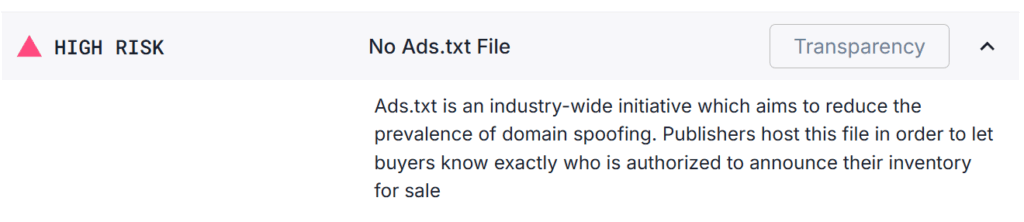
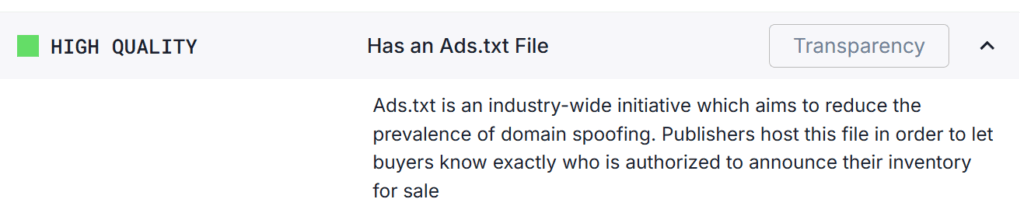
Publishers running programmatic advertising are expected to host a valid ads.txt file. We flag absence of this as a high risk signal in our metrics and presence of this as a high quality signal.
Size of ads.txt
The size of an ads.txt file reflects the number of authorized sellers. While large files are not inherently non-compliant, they may indicate heavy reseller chain layering and increased supply chain fragmentation. We flag these with a risk signal.

We also look for sites with an anomalously low number of ads.txt rows as this often indicates very young, potentially templated sites.

Verification of ads.txt
DeepSee also validates whether seller IDs declared in ads.txt can be found in the corresponding sellers.json file.
We display one of several flags, based on the results of this check:




Ads.txt has become a baseline infrastructure for advertising on the open web, but presence alone does not guarantee transparency. The real signal lies in how complete, accurate, and verifiable a domain’s authorization data is. By analyzing ads.txt alongside sellers.json and related transparency indicators, DeepSee.io provides a clearer view of supply chain integrity – helping buyers identify trustworthy inventory and helping publishers maintain monetization paths that are both efficient and fully authorized.