Ad Exchange
Definition & Explanation
An ad exchange is a technology platform that facilitates the automated buying and selling of digital advertising inventory through real-time auctions.
Exchanges sit at the center of the programmatic supply chain. Supply-side platforms (SSPs) aggregate publisher inventory and connect it to exchanges; publishers make their available ad slots accessible through the exchange. On the demand side, buyers, typically operating through demand-side platforms (DSPs), submit bids for those impressions, exchanges connecting inventory to DSP demand.
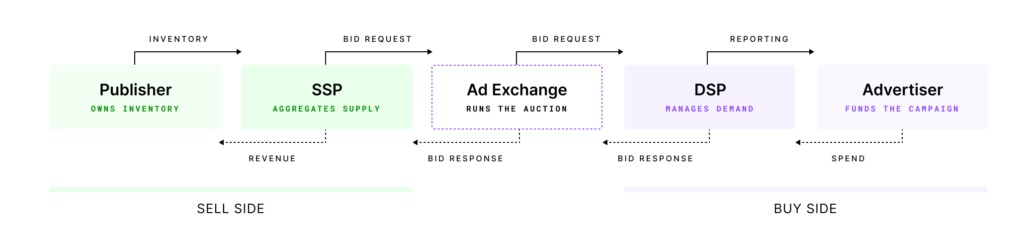
In practice, the distinction between SSP and exchange has largely collapsed. In the early days of programmatic, the two were functionally separate; SSPs were the software publishers used to list inventory, while exchanges were the neutral marketplaces where auctions cleared. That separation has eroded. SSPs built their own auction logic to handle header bidding and unified auctions; the additional layer added cost without adding value; and supply path optimization has pushed large DSPs to connect directly to whoever holds the direct publisher relationship, bypassing pure intermediaries. Most of the platforms now described as exchanges: Magnite, Index Exchange, PubMatic among them, operate as both simultaneously.
When a user loads a page, the publisher’s ad server sends an ad request to the exchange, which immediately opens a real-time auction. DSPs receive the bid request, containing information about the placement, the page, and where available, the user, and respond with a bid. The exchange evaluates all bids, declares a winner, and returns the winning creative to the page. The entire process typically completes in under 100 milliseconds. (1)
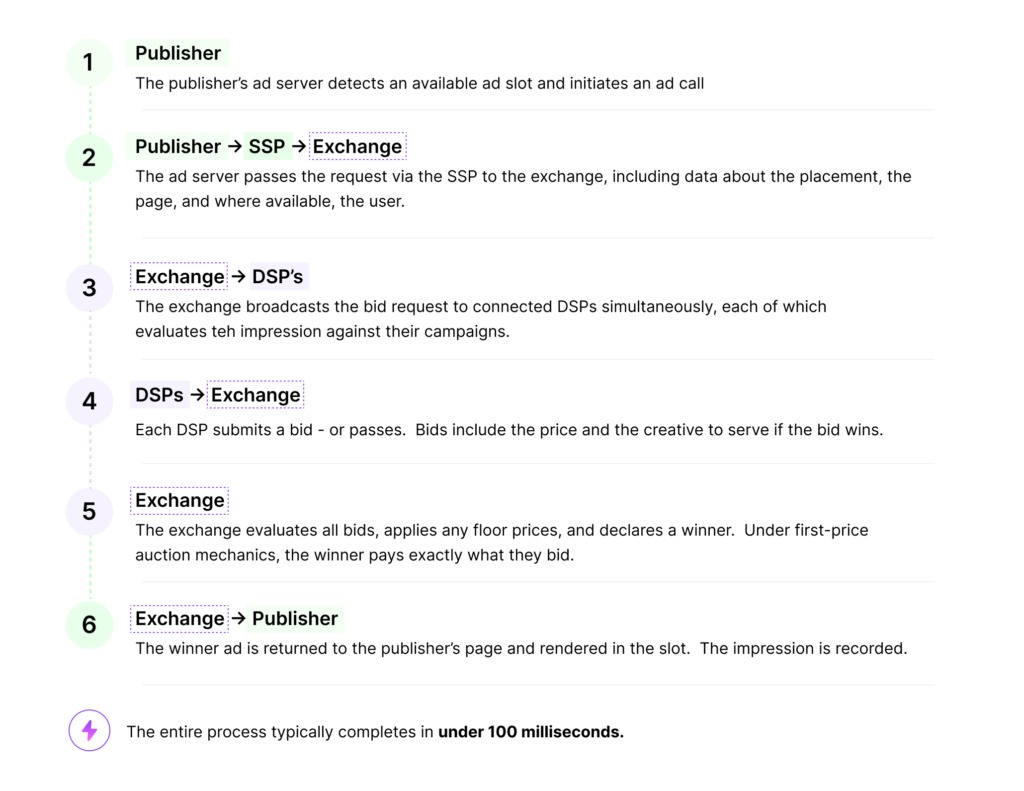
Most exchanges today run on a first-price auction model, a standard that solidified across the industry around 2019. In a first-price auction, the winning bidder pays exactly what they bid. This replaced the second-price model, where the winner paid one cent above the second-highest bid, a structure that naturally kept prices in check. Under first-price, that moderating mechanism is gone. Buyers responded by developing bid shading, an algorithmic approach to reducing bids below true willingness-to-pay to avoid overpaying, and floor prices set by publishers and SSPs became a more significant factor in what buyers actually pay. (2)
Why It Matters
The exchange layer is where inventory quality problems are hardest to see and easiest to exploit. Because exchanges operate at scale and speed, a buyer committing spend through a DSP has limited visibility into what they’re actually purchasing at the moment of the auction. Domain spoofing, artificially inflated impression volumes, and MFA inventory all enter the supply chain through exchange transactions.
Floor prices set at the exchange level also shape what buyers pay independently of true market demand. Publishers and SSPs can configure price floors that inflate CPMs without any corresponding signal of quality, a dynamic that makes pre-bid intelligence particularly valuable for buyers who want to understand what they’re purchasing before they bid.
DSPs respond to this opacity partly through target and block lists, curated sets of domains or inventory sources that are either prioritised for spend or excluded entirely. A well-maintained block list keeps budget away from low-quality or fraudulent inventory; a target list concentrates it on exchanges and publishers that consistently meet quality thresholds.
Ad Exchanges Across the Ecosystem
The major exchanges, Google Ad Exchange (now part of Google Ad Manager), Xandr, Index Exchange, Magnite, and OpenX among them, collectively handle billions of auctions per day. The exchange layer is concentrated: a relatively small number of platforms account for the majority of programmatic spend, which gives them significant influence over industry standards, floor pricing behavior, and access policies.
The IAB Tech Lab’s ads.txt and sellers.json standards were designed specifically to address transparency gaps at the exchange layer. (3) Ads.txt allows publishers to declare which exchanges and resellers are authorized to sell their inventory; sellers.json allows buyers to trace the entities in a supply chain back to their source. (3) Adoption is widespread but uneven, compliance with both standards varies considerably across the long tail of open web inventory.
DSPs have responded to exchange-layer opacity by building their own supply quality controls. The Trade Desk, Nexxen, 6sense, Yahoo DSP, and others maintain lists of preferred or excluded inventory sources, and increasingly route spend toward exchanges and SSPs that meet minimum transparency standards. (4)
Ad Exchanges in DeepSee.io Metrics
We evaluate exchange relationships as part of a domain’s overall supply chain profile. When we crawl a domain, we identify which exchanges and resellers appear in its ads.txt file, cross-reference those entries against the relevant sellers.json files, and flag gaps in authorization coverage. A domain whose ads.txt entries cannot be matched to valid sellers.json records presents a meaningful transparency risk, the inventory may be sold through unauthorized paths.
We also track exchange-level signals in aggregate. Domains that route inventory through a large number of resellers, or whose ads.txt files have grown to several thousand lines, often reflect fragmented supply chains where the actual authorized seller is difficult to identify. These patterns are surfaced alongside other quality signals, such as user experience and brand safety, to help buyers evaluate exchange relationships in context rather than in isolation.
Sources
- IAB Tech Lab: OpenRTB Specification
- Prebid.org: First Price Auction and Bid Shading Overview
- IAB Tech Lab: ads.txt Specification
- ANA: Programmatic Media Supply Chain Transparency Study, 2023