IVT (Invalid Traffic)
Definition & Explanation
Invalid traffic is traffic or ad activity that does not represent a genuine human opportunity to see an ad, and that should therefore be excluded from billable measurement. The Media Rating Council chose the term deliberately in place of “fraud,” because much of what qualifies is not malicious. Search crawlers, uptime monitors, and browser pre-fetch all generate ad calls no person will ever see. They are invalid for the same reason a bot farm is invalid, even though nobody set out to steal anything.
The MRC divides invalid traffic into two categories, split by how difficult the traffic is to detect rather than by intent (1):
- General Invalid Traffic (GIVT): identified through routine, list-based filtration. Declared bots and spiders from published lists, non-browser user agents, known data center IP ranges, and pre-fetch or pre-rendered traffic. Any accredited measurer is expected to catch it.
- Sophisticated Invalid Traffic (SIVT): identified only through advanced analytics, multi-point corroboration, and human investigation. Hijacked devices, sessions, ad tags, and creative. Malware and adware-driven traffic. Injected ads, and placements that are hidden, stacked, or otherwise obscured. Falsified location and device signals. Misappropriated content, which is where domain spoofing sits. Manipulated measurement events such as automated clicks.
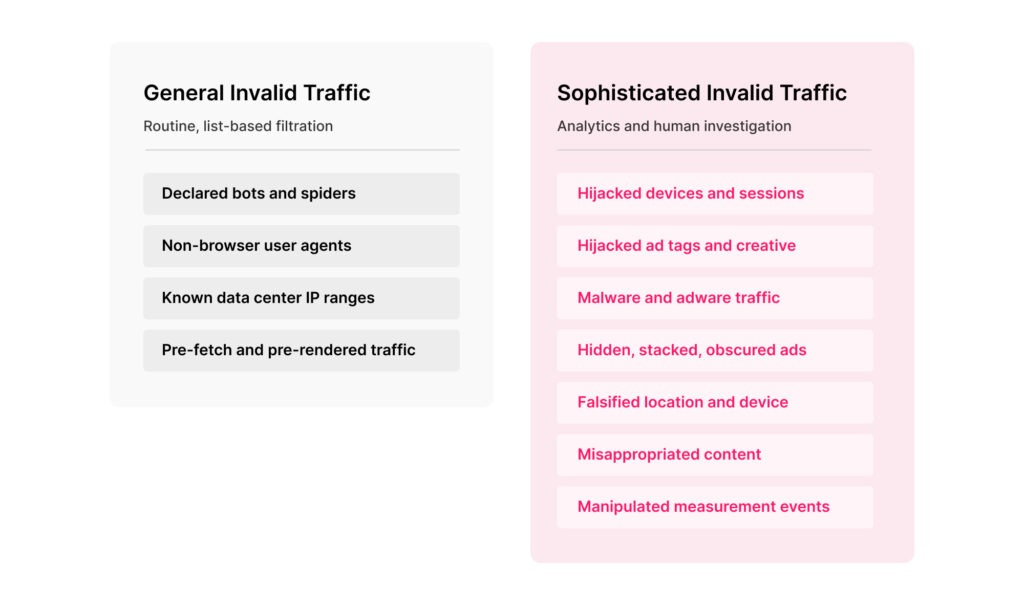
Accreditation is granted separately for each category, and SIVT accreditation subsumes GIVT, since catching the harder class presumes catching the easier one.
Detection itself happens tag-side, at the moment of delivery, and buyers act on it at two points. Pre-bid avoidance uses vendor segments inside the DSP to decline bids on inventory or devices already known to be invalid. Post-bid detection identifies invalid impressions after they have been served, removes them from billable counts, and triggers a credit or make-good. The first prevents the spend, the second recovers part of it after the money has already moved.
Why It Matters
The most misleading thing about IVT is the reassurance the headline number provides. Invalid traffic in TAG Certified Channels has been held below 1% in the US since 2021, reaching 0.82% in the 2023 benchmark, and most agency holding companies now write a sub-1% threshold into client contracts (2). That figure describes filtered traffic inside protected supply, not the supply itself. DoubleVerify’s 2026 CTV research measured fraud rates under 1% in protected campaigns against nearly 9% in unprotected ones (3). The number buyers quote is a property of the protection, not of the inventory.
Detection coverage is the second gap. When the MRC overhauled its guidelines in 2020, it introduced a required Decision Rate calculation specifically so users could see what share of traffic a vendor actually rendered a decision on (4). A low IVT rate across thin coverage means very little, and until that disclosure existed, buyers had no way to tell the difference.
The third gap is the one IVT was never built to close. MFA sites pass invalid traffic checks because their visitors are real people loading real pages. Nothing about an individual impression is invalid. A campaign can report a clean IVT rate while a meaningful share of its budget lands on inventory that no buyer would defend. Invalid traffic measurement answers whether an impression was real. It does not answer whether it was worth buying.
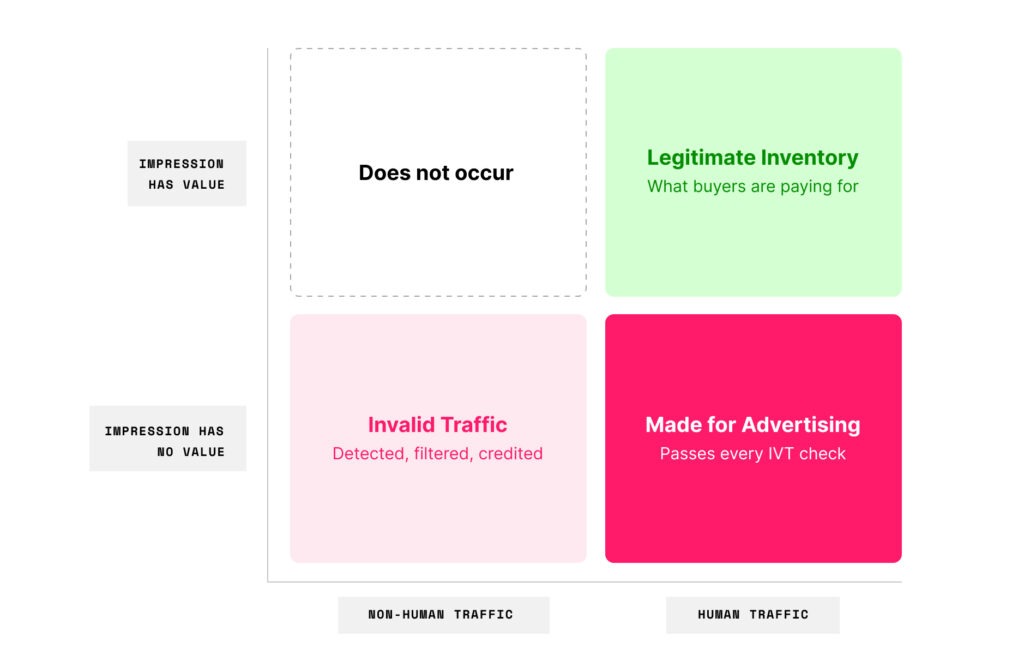
Assumptions about which channels are safe fail in the same way. DV found bot activity across multiple direct CTV buys from major advertisers, including one consumer healthcare campaign where 34% of impressions went to bots and a CPG campaign at 25%, both transacted through direct deals (3).
IVT Across the Ecosystem
The MRC issued its Invalid Traffic Detection and Filtration Guidelines Addendum in October 2015, then rebuilt it in June 2020. The update expanded GIVT baseline requirements, formalized traffic sourcing detection and disclosure, added guidance for logged-in environments, and introduced the Decision Rate requirement (1)(4). Accreditation under those guidelines is what makes a vendor’s IVT figure transactable, which is why verification is concentrated among a small set of accredited measurers rather than distributed across the market.
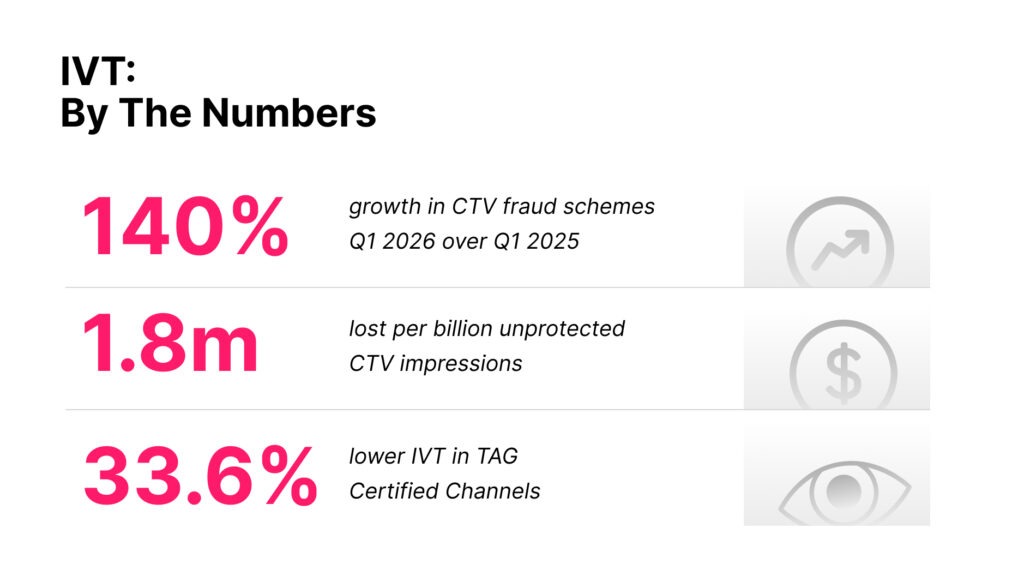
TAG’s Certified Against Fraud program supplies the other half of the infrastructure, applying anti-fraud standards to the entities in the chain rather than to the impressions passing through it. The 614 Group’s 2024 US benchmark analyzed 908.4 billion measured impressions and found IVT running 33.6% lower in channels where multiple certified entities handled the transaction than in channels with only one (5). Certification does not detect fraud. It removes the intermediaries most willing to carry it.
Fraud follows spend, and spend has moved to streaming. DV detected 140% more CTV fraud schemes and variants in Q1 2026 than in Q1 2025, uncovered more than 50 distinct CTV bot attacks during 2025, and identified ten times as many fraudulent CTV apps in 2025 as in 2024. It puts the cost to unprotected campaigns at roughly $1.8 million per billion CTV impressions served (3). The tactics vary by market: bot fraud accounted for 82% of violations in North America, while data center traffic dominated in APAC at 98%, LATAM at 91%, and EMEA at 66%. Only 21% of advertisers currently treat IVT or fraud detection as a CTV KPI at all.
Structural defenses sit alongside detection. Misappropriated content is an SIVT category, so the IAB Tech Lab’s authorization standards attack invalid traffic from a different angle: ads.txt and sellers.json let a buyer confirm that the entity selling an impression is authorized to sell it, which removes the cover a spoofed domain needs. Detection catches invalid impressions. Authorization makes some of them harder to create.
IVT in DeepSee.io Metrics
DeepSee does not measure IVT. It is a served-impression signal, captured tag-side during delivery and audited against an MRC-accredited standard, and the vendors who hold that accreditation already do it well. Our crawler visits sites the way a browser does, not the way a campaign does, so duplicating that measurement would add nothing.
What we measure is the environment the impression is served into, at the domain level and before the bid. Those signals fall into two groups.
The first maps onto the MRC taxonomy directly. We flag domains as spoofer or spoofed by comparing a site’s declared ads.txt and sellers.json authorization against what we observe its inventory doing, which is misappropriated content in SIVT terms. Our ads.txt verification checks feed the same picture: domains whose authorized paths cannot be matched to a relevant sellers.json entry are inventory a buyer cannot confirm is genuine.
The second covers what IVT filtration leaves behind. Our ACT list classifies arbitrage, ad clutter, and template sites, all of which clear invalid traffic checks on human traffic. Our ad refresh and ad density signals surface impression inflation that is entirely valid by the MRC definition and still degrades the value of every impression produced.
Sources
- MRC, Invalid Traffic Detection and Filtration Standards Addendum, 2015, updated June 2020
- TAG, 2023 US Fraud Benchmark Study
- DoubleVerify, Must-CTV: Streaming’s Shift From Promise to Performance, 2026 Global Insights
- MRC, Invalid Traffic Detection and Filtration Guidelines public comment draft announcement, February 2020
- TAG, 2024 US Fraud Benchmark Report, The 614 Group