
When a buyer evaluates app inventory, the store age rating is one of the first signals they lean on. It’s easy to read, it’s present on every listing, and for most of the catalog it’s a reasonable proxy: a Mature 17+ rating tells you to look closer, an Everyone rating tells you to relax.
We pulled store data on 4,346 AI character and companion apps- 1,464 on Google Play, representing roughly 610 million combined downloads, and 2,882 on Apple’s App Store, to see how well that signal holds up for one of the fastest-growing categories in mobile. It doesn’t.
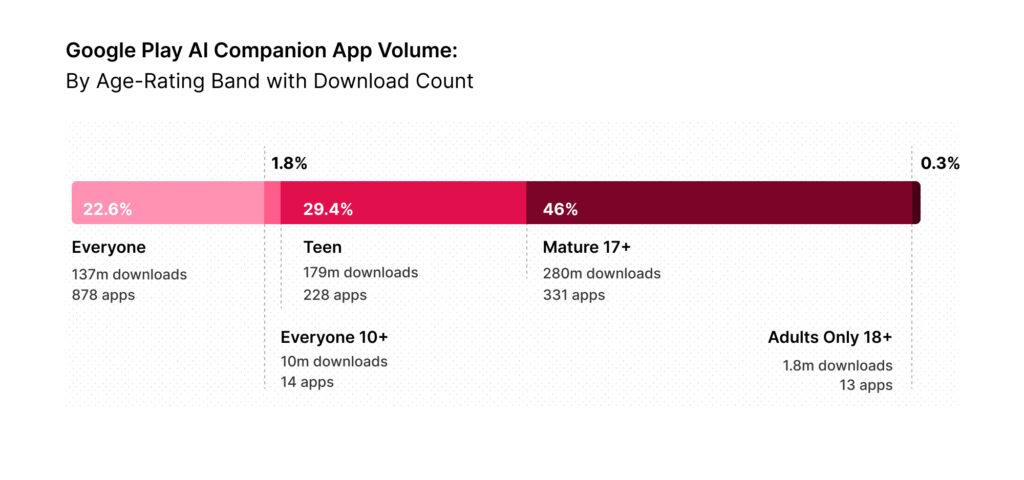
For AI companion apps, the age rating isn’t just weak. On Google Play it points the wrong way: the rating a buyer would use to screen out the riskiest inventory is the rating most of that inventory carries. On the App Store the picture is different- better at the head of the market, and arguably worse in the long tail, and the two stores frequently disagree about the same app. A signal that changes depending on which storefront you read it from is not a signal a buyer can build suitability rules on.
This is the same pattern we’ve been documenting in app environments all year. The verification chain a buyer assumes is intact, the signal that’s supposed to connect an impression to something accountable, turns out to depend on what the platform and the developer choose to declare. Companion apps are one area where that gap stops being a transparency problem and becomes a brand-suitability one.
What is an AI companion app?
An AI companion app is a chatbot built around a persistent persona and an ongoing relationship, rather than a task. Popular AI companion apps also sometimes let users chat with companions that others have made, such as: celebrities, fictional characters from TV & movies, or wholly original inventions. Where a general assistant answers a question and ends the session, a companion app is designed for the session to never really end: the character remembers you, messages carry emotional weight, and the product’s success metric is the depth and duration of the relationship. Users chat with a “girlfriend,” a “soulmate,” an anime character, a therapist-like confidant- sometimes one the developer designed, sometimes one another user created.
The category defines itself in its own marketing language. Our research team analyzed the titles and store descriptions of thousands of AI apps across both stores, measuring which terms are statistically overrepresented in companion apps compared with AI content generators and other AI apps. In titles, the signature terms are character, companion, girlfriend, virtual, and friend. In descriptions, companion apps are the category that talks about conversations, talk, personalities– and she and her. Among two-word phrases, meaningful conversations and emotional support are overrepresented in companion-app listings on both stores. Content generators, by contrast, are defined by video, art, music, and image; “other AI” is mostly translators and camera scanners. The relationship is the product, and the listings say so.
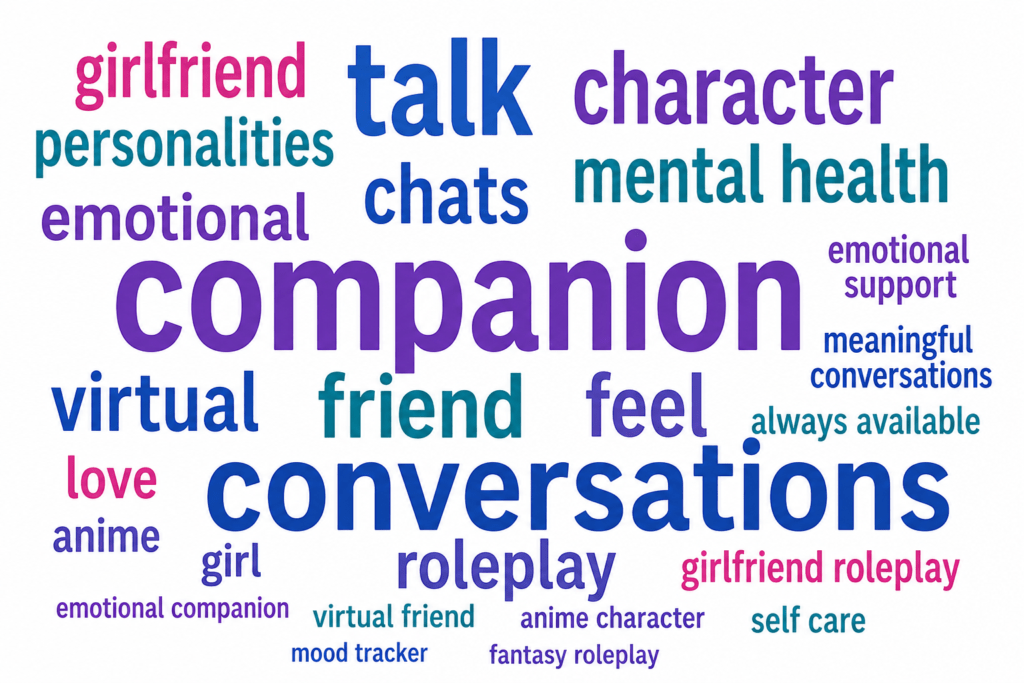
One finding from that analysis deserves its own flag: mental health is among the most overrepresented phrases in companion-app titles on Google Play, and in companion-app descriptions on the App Store. In practice, a user who searches an app store for mental-health help is disproportionately likely to be shown an AI companion. Research on these apps has found mixed mental-health effects- emotional validation and social rehearsal on one side; over-reliance, withdrawal, and increased language around loneliness and suicidal ideation on the other (1).
What we found across the category
Across both stores, 2,589 of the 4,346 apps, 60%, carry a rating that classifies them as accessible to minors: Teen or lower on Google Play, 12+ or lower on the App Store.
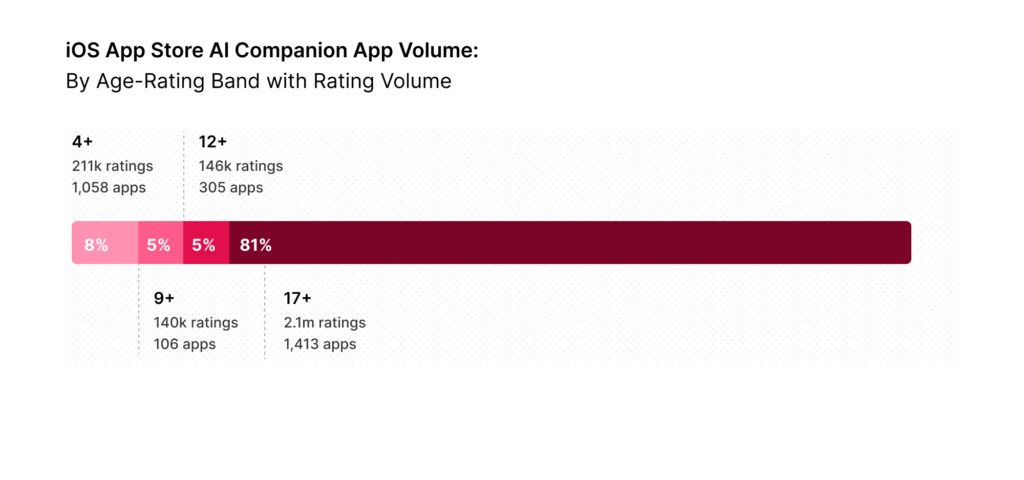
On the App Store, 1,469 of the 2,882 apps, 51%, are rated 12+ or lower, meaning Apple’s own screen-time controls treat them as appropriate for children. More striking: 1,058 apps, over a third of the entire iOS set, are rated 4+, the rating Apple assigns to content with “no objectionable material.” That band includes apps literally named AI Boyfriend Chat – Husby and ChatBot My Virtual Girlfriend.
Independent research from the family-safety company Aura, analyzing the most-used GenAI apps among children, found that the single largest category of companion interaction is sexual or romantic roleplay at 36.4%, followed by creative make-believe at 23.2%. Homework help, the use case platforms tend to cite, accounts for 13.1%. Aura also found messages in these apps run roughly ten times longer than texts to friends: about 163 words per message versus 12 (2). The engagement is deep, private, and, by the platforms’ own data, predominantly romantic.
So the signal and the content disagree. The rating says “general audience”; the usage data says “romantic roleplay with a heavily teenage user base.”
The rating doesn’t track the content
The clearest way to see the inversion is to read the titles against the ratings. These are not apps whose nature is hidden:
- HotChat – Your AI Soulmate: rated Teen, 5M downloads
- Crave AI – AI Soulmate: rated Everyone, 5M downloads
- Honey Chat – AI Girlfriend: rated Teen, 5M downloads
- Dokichat – Romantic AI Chats: rated Everyone, 1M downloads
- AI Girlfriend: Romantic Chat: rated Teen, 1M downloads
- Kawaii AI: Chat AI Girlfriend: rated Everyone, 1M downloads
The largest mainstream companions sit in the same band: Character.AI and Talkie are both rated Teen, at 50 million downloads each. The pattern holds at the explicit end too. One app named Sexy Chatbot X – No Filter AI is rated Everyone and reports a million downloads.
The rating moves, and not always toward safety
A rating would be more trustworthy if it converged on accuracy over time. In this category it drifts in both directions, on both stores.
On Google Play, 56 apps in our set have changed rating. Most tightened- PolyBuzz, the app Aura singled out for its 163-word messages and romantic-heavy content mix, moved from Teen up to Mature 17+, meaning it spent its growth phase rated for teenagers before tightening. But several apps loosened their rating, all of which are romance or companion apps:
- Replika: My AI Friend (10M downloads): Mature 17+ → Teen
- Vivy AI: Chat, AI Girlfriend: Mature 17+ → Everyone
- Mila: AI Roleplay Game: Mature 17+ → Everyone
- Scarlet AI Girlfriend Roleplay, Flirtify – AI RolePlay Chat, Stipop: AI Chat·Virtual Dating: Mature 17+ → Teen
On the App Store the churn is heavier and more evenly split: 252 apps changed rating, 132 loosening against 120 tightening. Fifty-seven of the loosening apps dropped the full four tiers, from 17+ down to 4+, from “adults only” to “suitable for preschoolers” with no intermediate stop. AI Chatbot – Nova, one of the most-reviewed apps in the iOS set at roughly 122,000 ratings, went from 17+ to 9+.
A rating that can drop two, three, or four tiers while the product stays the same is not a stable signal. It’s a self-declaration, and self-declarations move with the developer’s incentives.
iOS vs. Android: same app, different audience
306 apps in our set are live on both. The disagreement is lopsided:
- 106 apps are rated as accessible to minors on Google Play but 17+ on the App Store.
- Only 4 run the other way.
The apps in that first group aren’t obscure. Character.AI, 50 million Google Play downloads, rated Teen there, is 17+ on iOS. Replika is Teen on Google Play and 17+ on iOS. So are girlfriend-branded apps like Urvashi: Indian AI Girlfriend and AIA: AI Girlfriend Roleplay. The identical product, submitted by the identical developer, is declared appropriate for a 13-year-old on one store and adults-only on the other.
The head of the iOS market is, to Apple’s credit, mostly rated the way the content would suggest: apps rated 17+ make up 49% of iOS listings but capture 81% of all ratings volume, and the biggest names- Character.AI, PolyBuzz, Chai, Replika, all sit at 17+ there. If a buyer only ever bought the top of the App Store, the rating system would look like it works.
The long tail is where it breaks. Over a thousand iOS companion apps sit at 4+, dozens of them romance-coded by name, and the 17+ → 4+ drift shows the floor is no more enforced there than the Teen band is on Google Play. The honest summary is that neither store’s rating can be trusted on its face; they just fail in different places. Google Play at the head, Apple in the tail, and the cross-store disagreement is itself the tell that these are declarations, not classifications.
One structural note: Apple does not publish install counts, so download-based sizing is only possible on the Google Play side. On iOS, ratings volume is the best available proxy for where the engagement actually is, and 81% of it sits in 17+ inventory.
Spotlight: Character.AI, the best-defended app in the category
If any app in this set should have the problem solved, it’s Character.AI. It is the category’s flagship – 50 million Google Play downloads, founded by former Google researchers whom Google re-hired in a 2024 licensing deal widely characterized as an acqui-hire. It has also absorbed more legal and regulatory pressure than any of its peers: it is among the companies named in the FTC’s September 2025 inquiry, and by January 2026 it and Google had agreed to settle the leading wrongful-death suits (5, 6). As a direct result, it has built the most robust minor-safety apparatus in the category. What that apparatus amounts to is worth examining, because it is the ceiling, not the floor.
Start with the rating: Character.AI is 17+ on the App Store and Teen on Google Play. The same company, submitting the same product, declared two different audiences, and its own under-18 policy changes, announced under legal pressure in late 2025, sit closer to the iOS answer than the Android one.
Then the age gate. We tested the Android app’s mechanics directly, on a fresh device with a clean profile. An account declaring itself under 18 gets a genuinely locked-down experience: the user can browse public chats and create characters but cannot engage in open-ended chat dialogue.
The protection is nonetheless self-declared at its foundation. In our testing, the same device that had just been age-restricted could obtain a fully unrestricted experience within minutes by registering a new account with an adult birthdate. There is no document check, no verification step that outlasts the declaration itself. The gate holds against a truthful thirteen-year-old and yields to a lying one, and the entire category’s “Teen” and “4+” ratings rest on the same honor system, usually without even the lockdown.
That’s the spotlight finding in one line: the app with the strongest incentives in the industry, lawsuits settled, regulators watching, a trillion-dollar patron re-hiring its founders, still protects minors with a checkbox. Everything below it in the long tail protects them with less.
The bundle ID doesn’t track the app either
This is the part that should concern anyone relying on store metadata to identify what they’re buying, and it’s the same failure mode we found auditing app-ads.txt: a declared identifier that points somewhere unrelated to the thing it’s supposed to identify. In app environments, the developer URL can point anywhere; here, the bundle ID often describes a different app entirely.
- CrushAI: Chat, AI Girlfriend (100K downloads, rated Everyone on Google Play) runs on com.plusfunscanner.qrscan.code – a girlfriend chatbot on a QR-code-scanner identifier.
- AI Chat – AI Character Chatbot (100K, Teen) runs on beat.music.motion.tempo.video.editor.filmola – a character chatbot on a video-editor identifier.
- Stipop: AI Chat·Virtual Dating — the same app that loosened from Mature 17+ to Teen above — runs on io.stipop.sticker_platform, a sticker-SDK identifier.
- AI ChatBot GPTalk AI Generator (10M downloads, rated Teen on Google Play) runs on com.facebook.videodownload.videodownloaderforfacebook – an AI chatbot on a Facebook-video-downloader identifier.
A buyer reading the bundle ID to understand what they’re funding learns the wrong thing. The identifier and the app have come apart, exactly the way a declared developer URL and a genuine developer come apart in the ads.txt data.
There’s a related data-quality tell worth flagging: 10 apps in the Google Play set report at least a million downloads with zero ratings, including one, Mass: 3D Create & Play, claiming 10 million downloads and no reviews at all. Sexy Chatbot X – No Filter AI, the Everyone-rated app above, is another of the ten. A 10-million-to-zero ratio is the kind of anomaly that should prompt a closer look at how those install counts were generated.
Why this is a category problem, not an app problem
The instinct is to handle this with a block list of named apps. The structure of the category defeats that. The set is dominated by a short head and a very long tail: the top 10 Google Play apps account for about 44% of all downloads, while 1,265 of the 1,464, 86%, have 100,000 downloads or fewer. On iOS the tail is longer still: nearly 2,900 listings, most with negligible review counts. They cluster under near-identical naming and developer conventions — 138 Google Play apps share bundle prefixes like com.ai and com.aichat, and new ones ship constantly. By the time a given app name reaches an exclusion list, the next ten clones are already live.
Two outside forces make the inventory less safe to sit in, not more. First, the free tiers are ad-supported, and a sub-industry has emerged to place ads inside companion conversations rather than around them, matching sponsored content to what the user is discussing. Companion subscriptions convert at well under 5% of users, so the pressure to monetize the rest through ads is structural, not incidental (3). Second, the category is under active legal and regulatory pressure: the FTC opened an inquiry (4, 5) into seven companies operating companion-style chatbots in September 2025, multiple wrongful-death suits are proceeding, and by January 2026 Google and Character.AI had agreed to settle the leading cases (6). Operators don’t restrict their own products and settle claims over a category that’s safe to be adjacent to.
What buyers can do
The takeaway isn’t “block AI.” It’s that the store age rating cannot do the job buyers are using it for in this category, and the bundle ID can’t either. Both signals are self-declared, both drift, and they don’t even agree with each other across stores for the same app.
Practically, that means treating AI companion apps as a named risk category in CTV and mobile buys, the way made-for-advertising sites and AI-slop inventory graduated from curiosities to standing exclusions, rather than trusting the rating to sort them out. It means scrutinizing the verification signals behind a listing (declared developer identity, bundle-ID coherence, review-to-install plausibility, cross-store rating consistency) rather than the rating on its face. And it means recognizing that “Teen and above” is not a safe floor on Google Play, it’s the band where the girlfriend-and-soulmate inventory actually lives, while on the App Store, a 4+ rating on a companion app is a claim, not a fact.
This is the kind of gap our app-environment work is built to surface, and it’s why we flag AI Companion Apps as a High Risk signal. The classification reflects what the data above describes: these are often unpredictable, unfiltered environments, many of them allow or encourage sexually suggestive interactions that bypass standard moderation, and they carry a distinct set of psychological, privacy, and societal risks on top of the adjacency problem.

Sources
- Zhang et al., “The Rise of AI Companions”, on mixed mental-health effects of companion chatbot use.
- Aura, Overconnected Kids: Digital Stress, Addiction-Like Behaviors & AI’s Powerful Grip (TECHWISE study and commercial data, ages 8-17).
- EMARKETER, “AI companions present big potential-but bigger risks-to advertisers.”
- Common Sense Media / Stanford, via Yahoo/AP, “Kids and teens under 18 shouldn’t use AI companion apps, safety group says.”
- FTC, statement and inquiry materials on AI companion chatbots (Sept. 11, 2025).
- CNN Business, on additional Character.AI wrongful-death lawsuits.