We’ve been working on this one for a while. Today, DeepSee.io is expanding beyond the open web: mobile and CTV app signals are live in the portal.
Look Up Any Mobile or CTV App
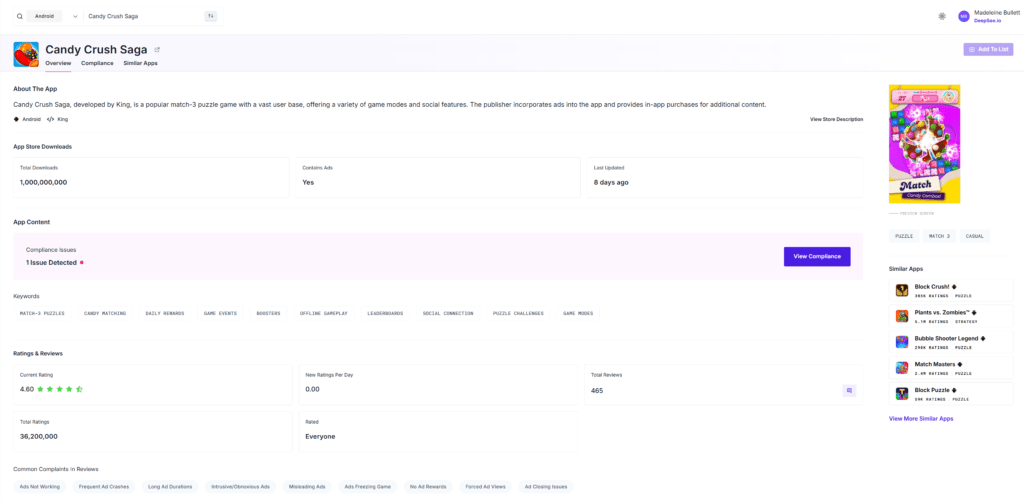
You can now search mobile and CTV apps directly in the portal and get a structured view of what’s behind them. The app overview page surfaces store metadata, download counts, whether the app declares it contains ads, ratings volume and trajectory over time, keyword context from the store listing, and review sentiment.
The Compliance Tab
The compliance tab brings the same signal structure you use on the web side to app environments. Risk signals, quality signals, and neutral signals are each labelled and categorised- brand suitability, discoverability, transparency, so you can see at a glance what’s flagged and why.
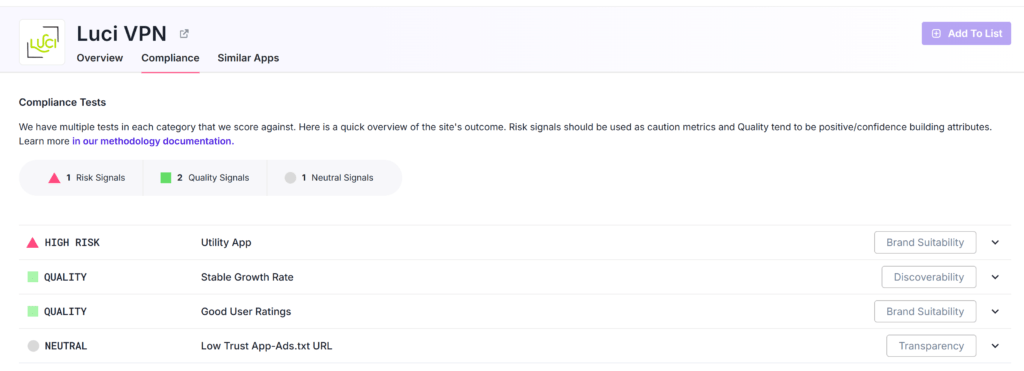
For the example above, the app is flagged as a Utility App under Brand Suitability- a high-risk signal our report goes into in detail. VPNs and similar utility apps often request device permissions that create a direct path to ad fraud, and 76.1% of apps flagged as potentially dangerous utilities on Amazon have no ads.txt file. The compliance tab also shows a Low Trust App-Ads.txt URL as a neutral signal- the app has a declared developer URL, but it doesn’t reflect genuine first-party developer infrastructure.
This is the distinction the signal is designed to surface. An app can check every formal box, declare advertising, list a privacy policy, point to an ads.txt file, and still fail the quality check underneath it. Across Google Play, nearly 250,000 apps technically pass the coverage check while hosting their privacy policy on free subdomain infrastructure with no real developer accountability behind it.
Why We Built This Now
We’re launching these signals alongside a new report: The App Environment Verification Blind Spot, which will be live next week.
The IAB Tech Lab published detailed guidelines for app and CTV inventory verification in 2019. They specified store ID formats, crawlable developer URLs, required meta-tags, and exactly how identifiers should travel through OpenRTB. The standard was workable. Five years later, large parts of the industry haven’t implemented it.
We audited apps across six platforms: Google Play, Apple App Store, Amazon Fire TV, Roku, Samsung Smart TV, and LG Smart TV, and measured how far the gap has widened.
On Google Play, 59.8% of apps have valid ads.txt files. On Roku, 14.1%. On LG, 8.7%. Samsung and LG don’t link to privacy policies at the store level at all. Apple, the world’s largest app store, still doesn’t implement the developer URL and bundle ID meta-tags the IAB specified in 2019.
The compliance gaps aren’t evenly distributed, either. They concentrate in the environments with the highest CPMs. CTV inventory typically commands $25–$40 against $4–$8 for web display. The premium that makes CTV attractive to advertisers makes it equally attractive to bad actors. On Roku’s movies & TV category, the inventory buyers most associate with premium CTV, only 18.5% of apps have ads.txt. These aren’t fringe publishers. They’re active programmatic supply with almost no supply chain documentation behind them.
The report covers what verification infrastructure actually exists across each platform, where it breaks down, what categories of risk move into the gaps, and practical steps buyers can take today.
API Access
App and CTV endpoints are available on any existing API plan, no upgrade required. Full documentation is at our API reference page.
Pricing
Portal lookups for mobile and CTV apps are free for all existing customers for the first month. After that, access is $800/month (or $7,680/year).
As always, we’d love to hear what you think. If you want a closer walkthrough of what’s new, reach out to the team anytime at [email protected].